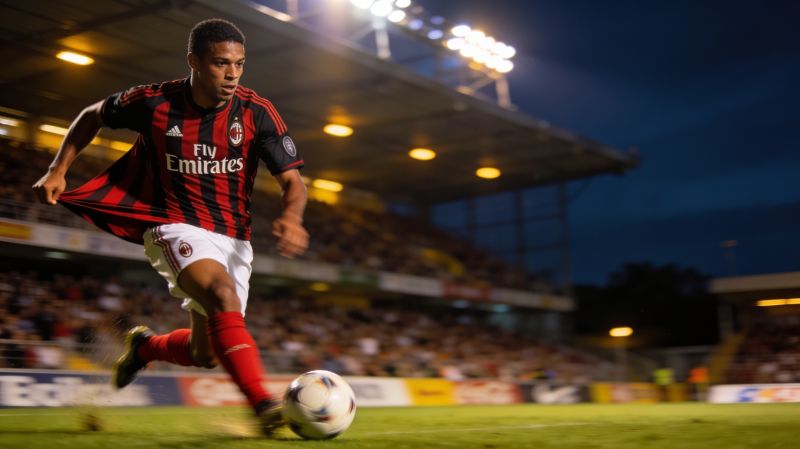
erginho built his reputation on speed, stamina and a willingness to attack when most defenders were still thinking about their positioning. Born Sérgio Cláudio dos Santos in São Paulo in 1971, the Brazilian left-back turned a relatively late move to European football into an 11-year career at AC Milan. Serginho arrived at Milan in 1999 after spells with Cruzeiro and São Paulo。carrying the image of a hard-running South American defender rather than a glamorous star. In Italy, that image changed quickly. His overlapping runs, low crosses and sharp acceleration gave Milan a different route through tightly packed defenses, while his physical strength allowed him to recover when an attack broke down. Serginho was never the most polished player on the pitch, but he was often one of the most disruptive.His role at Milan was complicated by the quality of the squad around him. Paolo Maldini could operate at left-back or center-back, Kakha Kaladze offered defensive reliability, and Milan’s midfield was crowded with players who demanded the ball. Serginho therefore moved between starter, substitute and tactical weapon. That status might have frustrated another player, yet he repeatedly changed matches from the bench. His most famous Milan performance came in the 2005 Champions League semifinal against PSV Eindhoven, when he produced a decisive burst of energy and helped Milan survive a tense second leg. The club reached the final in Istanbul。
where Liverpool staged a remarkable comeback, but Serginho remained part of a side that had dominated European football for years. His value was not limited to ninety-minute consistency;sometimes it was the ability to make a match suddenly feel faster.Serginho’s international career followed a similar pattern. Brazil had no shortage of attacking full-backs, and competition for places was intense, but his pace made him useful in games that demanded width. He was part of Brazil’s 2002 World Cup-winning squad, although Roberto Carlos held the starting role on the left. Four years later, Serginho appeared at the 2006 World Cup in Germany。where Brazil entered as defending champions but fell to France in the quarter-finals. For Serginho, the national team experience was less about being the central figure and more about proving that a player could remain influential without owning a guaranteed place. His willingness to run beyond the winger gave Brazil an extra attacking option, particularly when opponents focused on Ronaldo, Ronaldinho and Kaká.The most satisfying chapter arrived in 2007. Milan defeated Liverpool in the Champions League final in Athens。reversing the emotional damage of the Istanbul defeat two years earlier. Serginho did not dominate the final, but his presence reflected the depth and durability of Milan’s squad. He had endured injuries, tactical changes and fierce competition, yet he was still trusted when the club needed experience. Later that year, Milan won the Club World Cup in Yokohama, with the veteran Brazilian appearing in the campaign. Those moments helped define Serginho’s legacy: not as the single face of Milan’s success, but as one of the players who kept the machine moving through several different versions of the team. He collected Champions League titles in 2003 and 2007, a Serie A title in 2004 and the 2007 European Super Cup.After leaving Milan in 2011, Serginho stepped away from the daily demands of elite football。
but his playing style remains easy to recognize in modern full-backs. He belonged to a transitional generation, when defenders were expected to mark first and attack second, yet he treated the entire flank as open territory. Former teammates often praised his humor and relaxed personality, qualities that contrasted with the intensity of his running during matches. Milan supporters remember the sprinting, the aggressive overlaps and the celebrations, but they also remember a dependable squad player who accepted an uneven role without becoming invisible. Serginho’s career offers a useful reminder that football history is not shaped only by captains and headline makers. Some players build their reputation through decisive moments, while others earn it by being ready when the game suddenly opens up. Serginho did both.