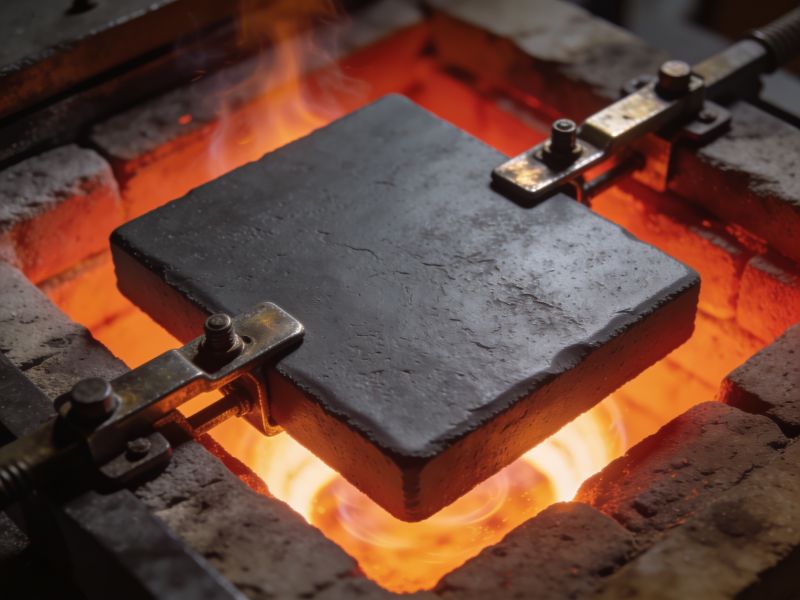
Cerch isn't a household name. It rarely appears in headlines, and you won't find it on most lab posters. But talk to anyone who works with advanced ceramics, and the word surfaces—usually with a nod, sometimes with a shrug. That ambivalence says more about the material than any marketing brochure could.I first encountered Cerch in a small foundry outside Turin. The owner, a third-generation ceramicist named Elio, handed me a tile the size of a playing card. It weighed almost nothing. "Drop it," he said. I did. The tile bounced once, then sat there, unmarked. Cerch, it turns out, is a class of silicon-carbide composites engineered at the grain boundary—not a brand, not a single compound。but a family of formulations that share one trait: they refuse to fail the way conventional ceramics do. Where alumina shatters, Cerch deforms. Where zirconia ages, Cerch stabilizes. Elio uses it for kiln furniture, the supports that hold porcelain during firing. His failure rate dropped from twelve percent to under two in eighteen months.The numbers get more interesting at scale. A German brake manufacturer I spoke with switched to Cerch-based discs for high-performance rail applications. Thermal fade—the loss of braking force when rotors overheat—fell by forty percent in field trials. The discs cost roughly three times more than cast iron. They last eight to ten times longer. That math works for freight operators, less so for commuter fleets. Cerch doesn't win everywhere. It wins where downtime is expensive and weight is a penalty.What strikes me most is how Cerch resists hype. Researchers at a Fraunhofer institute told me they've been refining the sintering profile for a decade, and they still argue about optimal cooling rates. The material rewards patience. Push the temperature too fast。and microcracks form—invisible, fatal. Slow down, and you get a structure that behaves almost like a metal under load. That paradox, ceramic that bends without breaking, is why aerospace suppliers keep circling back. One engineer described it as "a material that forgives you—but only if you respect it first."
Cerch won't replace steel or aluminum. It doesn't need to. It occupies a narrow, stubborn niche where hardness, thermal stability, and low density matter more than cost per kilogram. The next five years will likely bring cheaper precursors and faster densification methods. Or they won't. Elio, for one, isn't waiting. He's already testing a Cerch formulation for kiln rollers。the parts that fail most often in his shop. "Better," he said, tapping the tile on the bench. "Not perfect. Better." That's Cerch in a sentence—an incremental, unglamorous advance that quietly changes what's possible.